Important information about the highways and toll fees of 4+1 popular countries in 2026
2026. 02. 16. 13:44
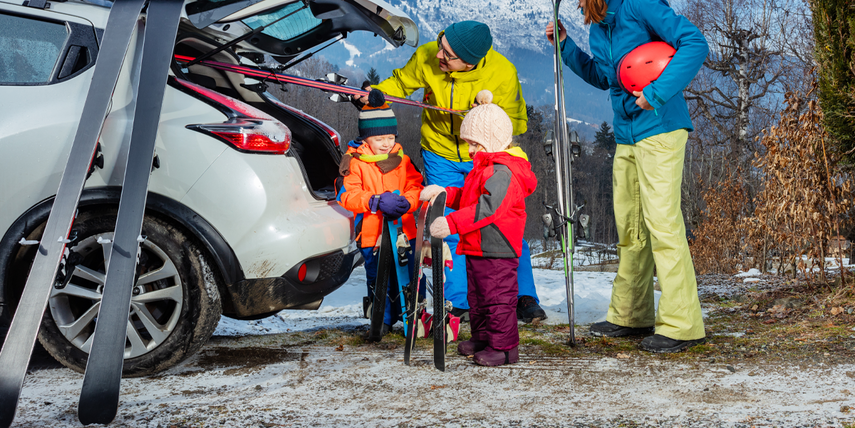
Tourism is not only about passive relaxation, but also about active recreation — and the winter ski season is a perfect opportunity for that. Although winter is slowly coming to an end, it is still worth taking advantage of the coming weeks and setting off on a trip.
If skiing is your goal, domestic ski parks can offer excellent experiences, but let’s take a look at the ski paradises of 4+1 popular countries that are just a few hours away — and one key factor: what you should know about the journey there.
Table of Contents
- Austria is a safe choice – Good value for money, easily accessible
- A practical choice: Slovakia – Proximity and affordable prices
- Poland – Charming Alpine atmosphere and affordable prices
- Panoramic experience – Italy for lovers of sunshine and Dolomite slopes
- A true ski experience in France – Vast ski areas and safety
- Don’t forget your Hungarian vignette either!
- Summary
- FAQ
Austria is a safe choice – Good value for money, easily accessible
Austria is one of the best destinations for a getaway, and skiers can enjoy excellent value-for-money services here. For winter sports enthusiasts, it is a stable and predictable choice: it is close, has excellent infrastructure, and offers ideal terrain for almost every need. Snow conditions are reliable, slopes are continuously maintained, there is a wide range of accommodation options, and it is easily accessible by car.
What should you know before departure?
Once you have selected the exact location and accommodation, all that remains is packing and preparing your car. Let’s see the important tasks that are worth taking care of before setting off.
Are winter tires mandatory in Austria?
In Austria, for all vehicles under 3.5 tons, winter tires are mandatory between November 1 and April 15 if the roads are snowy, icy, or slushy.
Are all-season tires a good choice in Austria?
All-season tires are only accepted if they bear the M+S (Mud + Snow) marking and have a minimum tread depth of 4 mm. With this in mind, the use of winter tires is recommended. Authorities regularly check compliance, and if the condition or type of tires does not meet the requirements, a fine will be imposed.
It is not worth taking the risk: fines range from €60 up to €5,000 if driving with inappropriate tires results in an accident.
Are snow chains mandatory in Austria?
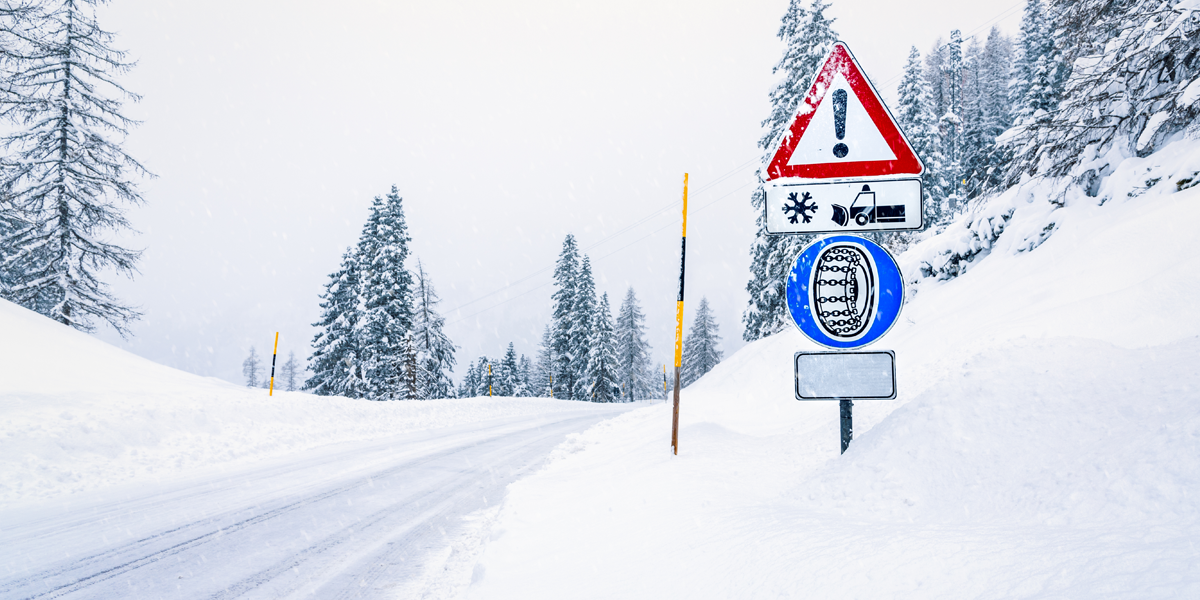
Snow chains are not mandatory on every road section; however, there are certain Alpine routes where road signs indicate that snow chains are required. To be prepared for unexpected situations, it is strongly recommended to pack snow chains in the trunk.
If you drive on a section where snow chains are mandatory — or where authorities require their use due to weather conditions — and you do not have them, you can expect a fine of €35.
Is a highway vignette required in Austria?
In Austria, vehicles under 3.5 tons are subject to two types of toll obligations:
- On highways: highway vignette
- On Alpine sections and in tunnels: section toll (route toll)
To legally use Austrian highways, an Austrian highway vignette is required in all cases. It can be purchased online or at petrol stations. In Austria, highway vignettes are available in two categories:
- A – Motorcycle: the 1-day vignette costs €3.80, and the 10-day vignette costs €5.10
- B – Vehicles under 3.5 tons and their trailers: the 1-day vignette costs €9.60, and the 10-day vignette costs €12.80
However, in addition to the vignette fee, if you travel on certain Alpine sections where maintenance costs are higher or where tunnels are located, you should also expect to pay a separate section toll. These toll routes can be planned online and can also be easily paid on site.
A practical choice: Slovakia – Proximity and affordable prices
Slovakia is an ideal country if you are looking for a skiing destination that is easily and quickly accessible from Hungary. For winter sports enthusiasts, it can be a great option for a longer stay, but it is also well worth it for just a weekend getaway. The High Tatras and Low Tatras provide a perfect mountain environment, suitable for both beginners and intermediate skiers. In addition to well-maintained slopes, the resorts feature increasingly modern lifts, and prices are generally lower than in Austria.
Important information if you are traveling to Slovakia by car
Slovakia is easily accessible by car, so in order to avoid fines, it is important to prepare for all potential situations and make sure to purchase a motorway vignette as well.
Are winter tires and snow chains mandatory in Slovakia?
Similarly to Austria, in Slovakia winter tires are mandatory for vehicles under 3.5 tons between November 15 and March 31 if road conditions or the authorities require their use.
For all-season tires, the minimum required tread depth is 3 mm. The use of snow chains may be required by the authorities, especially in the Low Tatras and High Tatras. Based on this information, if you are planning a skiing trip to Slovakia, the use of winter tires is strongly recommended, and it is also advisable to keep snow chains in your vehicle.
Is a highway vignette required in Slovakia?
Yes, the use of Slovak highways is also subject to a highway vignette, which can be easily purchased online. Toll payment is available in two categories:
- Vehicles up to 3.5 tons and, regardless of permitted weight, all two-axle vehicles in category M1 (e.g. passenger cars, motorhomes, minibuses, light commercial vehicles)
- Trailers: O1 and O2 category trailers, if the total combined weight of the trailer and the towing vehicle exceeds 3.5 tons
How much does a highway vignette cost in Slovakia?
Slovak highway vignettes are available with shorter and longer validity periods. For a weekend trip or a longer stay, a 1-day, 10-day, or 30-day vignette may be sufficient. In 2026, highway vignette prices for passenger cars in Slovakia are as follows:
| 1-day vignette | 10-day vignette | 30-day vignette |
|---|---|---|
| 8,10€ | 10,80€ | 17,10€ |
Poland – Charming Alpine atmosphere and affordable prices
Poland is an ideal choice if you are looking for an affordable yet experience-rich ski destination from Hungary. The Polish side of the Tatras offers a spectacular mountain environment, where skiing is combined with a pleasant town atmosphere and traditional alpine charm. The slopes mainly favor beginners and intermediate skiers, but more challenging terrain is also available.
It is worth traveling by car, as Zakopane and the surrounding ski resorts can be reached within approximately 4–6 hours. However, it is important to pay attention to the regulations here as well, so that a fine does not arrive while you are relaxing after your ski trip.
Are winter tires and snow chains mandatory in Poland?
According to current regulations, winter tires are not mandatory in Poland. However, they are strongly recommended when weather conditions justify it, such as during frost or snowy and icy road conditions.
If you are choosing Poland for skiing or a winter getaway, we recommend using winter tires and keeping snow chains in your vehicle, especially if you are heading to snowy mountain areas.
Is a highway vignette required in Poland?
In Poland, the highway toll system differs from the vignette system commonly used in Hungary, as there is no general nationwide e-vignette for passenger cars. Not all highways are toll roads, but tolls must be paid on several important sections, particularly on certain parts of the A1, A2, and A4 highways.
On toll sections, the most common solution is a barrier system, where drivers take a ticket upon entry and pay upon exit based on the distance traveled. Payment can be made in cash or by bank card.
Panoramic experience – Italy for lovers of sunshine and Dolomite slopes
Italy is a perfect destination if you are looking for a spectacular, experience-focused ski trip from Hungary. The iconic mountain ranges of the Dolomites not only offer excellent ski terrain, but also breathtaking panoramas and more hours of sunshine, which makes winter sports even more appealing for many travelers. In addition to skiing, Italian cuisine and charming Alpine villages further enhance the overall experience.
It is also worth traveling to Italy by car, as the popular ski regions can be reached within approximately 6–9 hours. Traveling by car also provides flexibility for transporting equipment and exploring local attractions.
Are winter tires and snow chains mandatory in Italy?
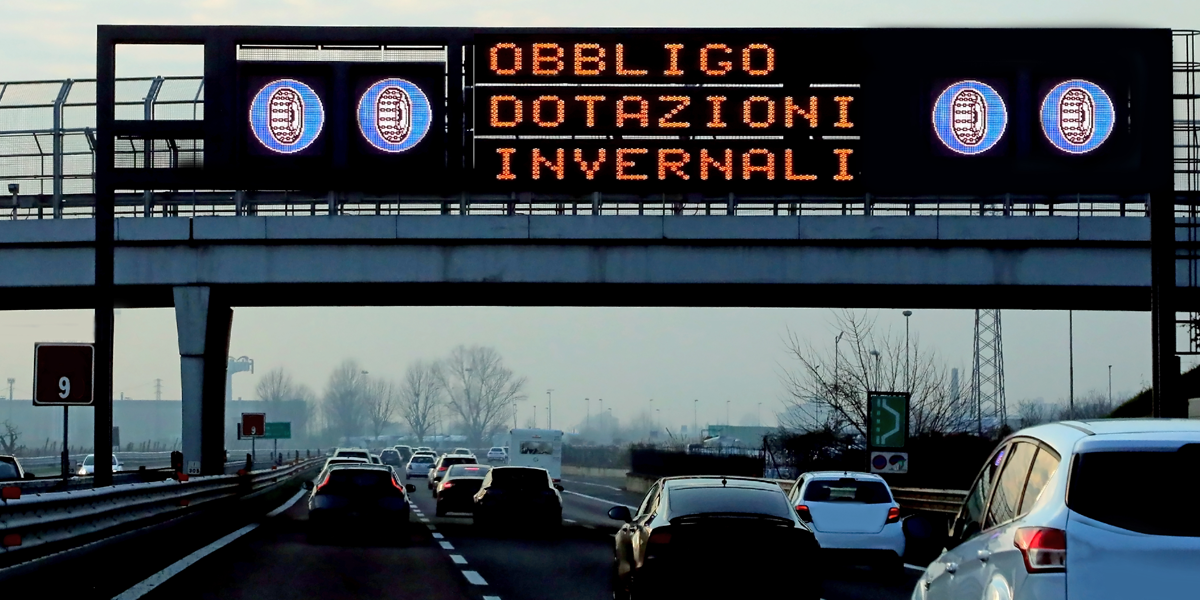
Winter tires are not universally mandatory in Italy; however, depending on weather conditions, local authorities may require their use. In the Aosta Valley, winter tires are mandatory between October 15 and April 15, while in other regions regulations are determined at a regional level. Accordingly, it is strongly recommended to arrive with winter tires, as roads leading to ski resorts are more likely to have specific requirements.
The use of snow chains is not mandatory in every case, but mountain roads may display signs indicating that snow chains are required. Therefore, it is advisable to keep snow chains in your vehicle.
Is a highway vignette required in Italy?
No. Similarly to Poland, Italy operates a barrier-based toll system, meaning distance-based toll payment applies. The amount depends on the vehicle category and the distance traveled, but for passenger cars the costs are generally predictable and easy to calculate.
A true ski experience in France – Vast ski areas and safety
France is an ideal destination if you are looking not just for a quick ski getaway, but for a truly large-scale Alpine experience. The ski resorts of the French Alps are world-renowned, offering vast interconnected slope systems, modern lifts, and high-altitude, snow-sure locations.
From Hungary, France is typically reached after a longer journey, which is why most Hungarian skiers choose it for week-long or multi-day ski trips. Traveling by car is also an option; although the distance is greater, the scale and quality of the ski experience more than compensate for the travel time for many visitors. Due to the longer journey, it is strongly recommended to properly prepare your car for winter conditions.
Are winter tires and snow chains mandatory in France?
In France, winter tires are not mandatory nationwide in all areas. However, on certain sections marked by road signs, snow chains are considered mandatory equipment, and their use is required when indicated.
Is a higwhay vignette required in France?
France has a highly developed highway network, which is one of the key pillars of the country’s transport infrastructure. The system is largely toll-based, and payment is distance-based rather than time-based as in Hungary’s vignette system. When entering the motorway, you receive a ticket, which you must pay for upon exit according to the length of the section traveled. Toll fees are considered medium to high by European standards, especially for longer highway journeys.
Don’t forget your Hungarian vignette either!
While organizing your trip abroad, it is easy to forget about your domestic highway vignette. So don’t forget: if you plan to travel on the highway to the border, make sure to purchase your Hungarian e-vignette in advance.
What should you pay attention to?
- If you are traveling for several days, a 10-day vignette may be more cost-effective than buying two daily vignettes, and you won’t have to worry about coverage for your return journey.
- If you will still need a vignette after your trip, it may be more economical to choose a monthly or county (regional) vignette.
Play it safe: purchase your highway vignette and travel freely both domestically and abroad!
Summary
February is still an excellent opportunity for a great ski trip, whether you choose domestic ski resorts or those in neighboring countries. However, it is important to prepare your vehicle properly for winter conditions and, if possible, purchase the necessary highway vignettes in advance, comfortably and without stress at home.
FAQ
Where are winter tires mandatory?
In most European countries, winter tires are strongly recommended during the winter months, and in Alpine, snowy, and icy regions they may be mandatory during certain periods. Countries such as Austria, Slovakia, and Italy have seasonal or regional requirements, while in Poland, France, and Hungary winter tires are not mandatory but strongly recommended.
What happens if I forget to purchase a highway vignette?
In Austria and Slovakia, there is no official grace period; the highway vignette must be purchased before entering a toll road. In contrast, in Hungary you have up to 60 minutes after entering the highway to purchase the vignette and avoid a fine.
What should I pay attention to when purchasing an e-vignette?
In addition to selecting the correct vehicle category and validity period, it is extremely important to enter your license plate details accurately. Even a single incorrect character can result in a fine. Once the details are correct, make sure you receive an email confirmation verifying the successful purchase and validity of your e-vignette.